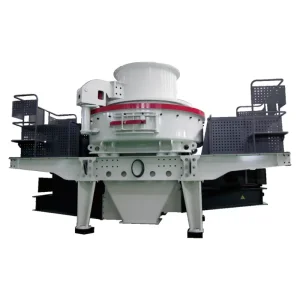
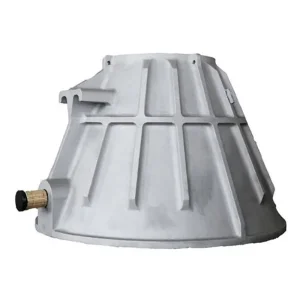
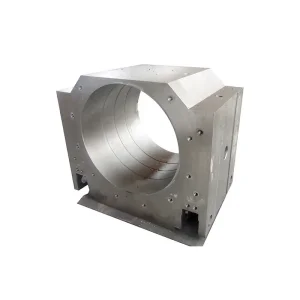
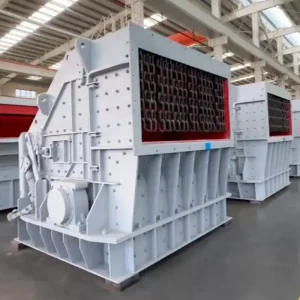
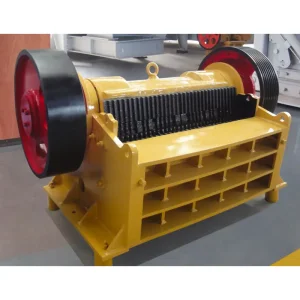
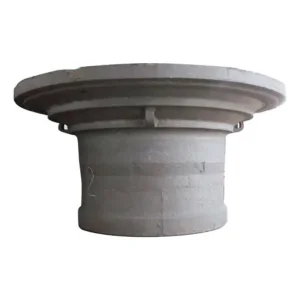
Explore our flagship heavy castings and processing equipment designed for global metallurgy, power generation, and crushing plants.
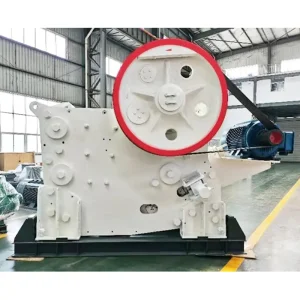
In the field of heavy aggregate production, mining, and slag reduction, the Double Toggle Jaw Crusher (historically known as the Blake-type crusher) remains the gold standard for processing extremely hard, abrasive, and tough materials. Unlike single-toggle jaw crushers where the moving jaw undergoes a complex elliptical movement that combines crushing and grinding forces, the double-toggle mechanism utilizes a pure pivoting action. This kinematic design keeps mechanical wear on the manganese plates to an absolute minimum by reducing vertical scrubbing, translating to extended wear life and lower operating costs.
The mechanics of the double-toggle crusher rely on an eccentric shaft situated at the top, which drives a heavy pitman vertically. As the pitman rises and falls, it pushes two distinct toggle plates: one connected to the rear frame, and the other linked directly to the swing jaw. This dual-lever mechanical leverage generates massive compressive forces at the bottom of the crushing chamber, easily shattering high-hardness rocks, slag, and iron ores. This makes the design particularly favored in primary crushing installations where the feed materials exhibit compressive strengths exceeding 300 MPa.
The pure downward and inward swinging arc of the moving jaw plate virtually eliminates rubbing actions, preserving the corrugations of jaw liners and lowering energy requirements per ton.
Constructed utilizing high-strength cast steel alloys, the frames are engineered to absorb huge shock loads without structural deformation, assuring decades of operational service.
Designed with sacrificial toggle plates that shear under uncrushable tramp iron events, protecting expensive eccentric shafts, bearings, and heavy structural castings from catastrophic failure.
Because every mining site and metallurgical plant operates under unique conditions, standardized off-the-shelf crushers often fall short. A premier OEM manufacturer must provide comprehensive engineering customizations. At Henan Hanhai Metallurgy Mining, we specialize in translating specific customer parameters into custom-machined cast steel components, heavy-duty frames, and customized jaw crusher profiles. We adapt the crushing chamber design, toggle seat geometries, and flywheel weight distributions to optimize the mechanical advantage according to the client's feed material.
Whether you are dealing with abrasive iron ore in South America, river gravel in Southeast Asia, or steel slag in Europe, the metallurgy of the jaw plates must be carefully selected. We offer high-manganese steel jaw plates ranging from 13% Mn (for standard applications) to 18% Mn and 22% Mn with added chromium or molybdenum to prevent early wear and maximize uptime. Our OEM support covers critical components including the eccentric shaft (fabricated from high-grade forged alloy steel), heavy-duty pitmans, cast steel cheek plates, and custom-machined bearing housings designed to handle dust-heavy mining environments.
Delivering robust structural steel and cast iron elements to international industrial partners.
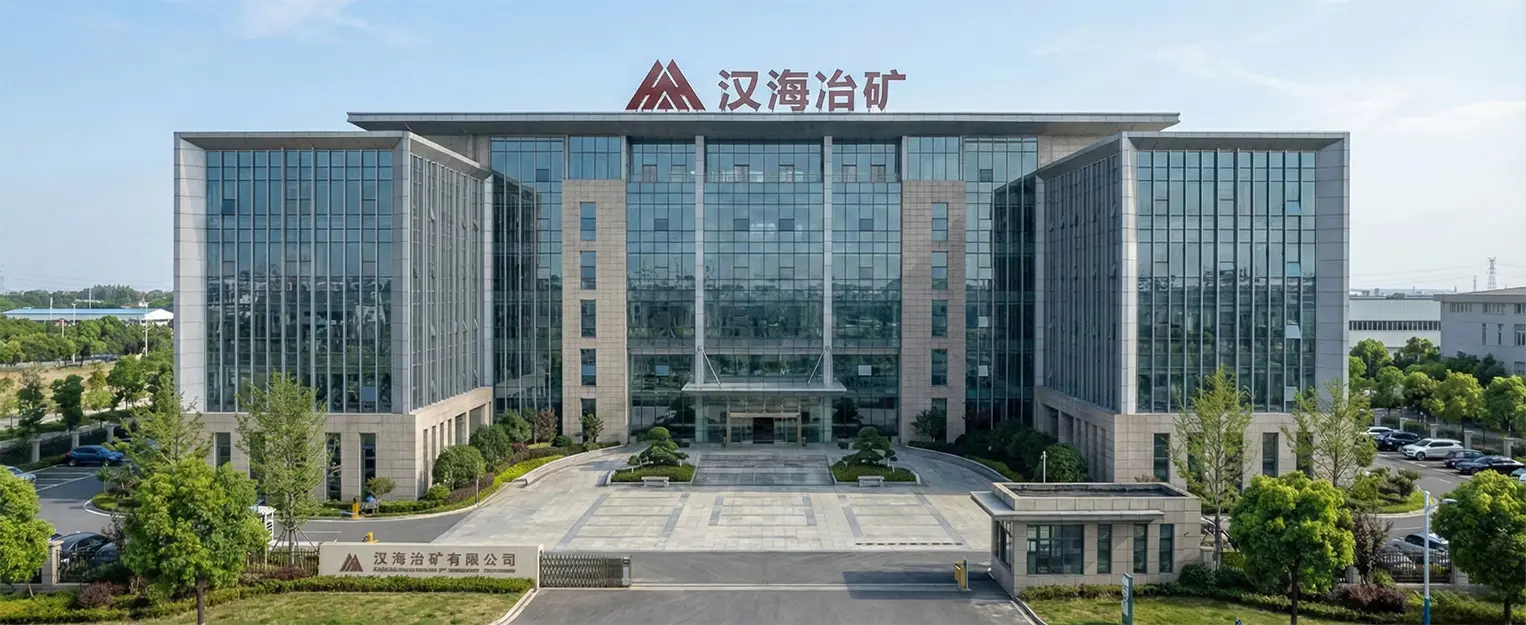
In the modern industrial landscape, procurement departments do not just purchase machinery; they buy into a supplier's ecosystem. The migration toward China Industry 4.0 has transformed local casting factories into advanced, digitally-monitored manufacturing units. Our facility integrates automated sand preparation plants, digital simulation of the casting pour to detect potential shrinkage porosity before molten metal is poured, and state-of-the-art CNC horizontal boring machines. This guarantees that every large-scale steel casting, such as a 25-ton double-toggle frame, aligns perfectly with global drawing standards (including ASTM, DIN, and JIS).
Supply chain resilience is another major advantage of partnering with a mature Chinese manufacturer. By consolidating raw material supply, structural casting, heat treatment, precision machining, and non-destructive testing (such as Ultrasonic and Magnetic Particle Testing) inside one geographic and operational cluster, we reduce lead times by up to 30%. This integrated capability prevents production bottlenecks and guarantees steady delivery schedules to overseas buyers who cannot afford downtime on major mining infrastructure projects.
Purchasing heavy crushing machinery and high-weight casting parts across borders introduces several critical risks that purchasing directors and plant operations managers must navigate:
Over two decades of dedicated metallurgy research, continuous foundry upgrades, and international partnerships.
Hanhai Casting launched its first heavy steel and iron foundry, establishing the baseline metallurgy and production workflows required for heavy industrial castings.
Introduced advanced melting furnaces and electric sand preparation systems. Expanded the manufacturing base to serve the domestic cement, mining, and heavy industrial press markets.
Standardized our quality testing apparatus, gained official CE and ISO9001 credentials, and built solid export partnerships across Asia, Europe, and the Middle East.
Adopted Industry 4.0 digital simulations, optimized chemical composition control systems, and expanded custom manufacturing workflows for mining machinery and heavy industrial valves.
A step-by-step engineering-driven methodology to minimize design risks and guarantee premium product delivery.
We review the operating parameters, mineral properties (hardness, abrasiveness), and output requirements to select structural characteristics.
Using finite element analysis and solidification simulations to identify stress points and optimize the layout of the cast frame before pouring.
Modern pattern making and automated sand molds secure accurate shape profiles. Electric arc furnaces pour the molten steel at strict temperatures.
Normalizing, annealing, or tempering processes are executed in-house to refine grain structure and maximize impact toughness of the final casting.
Critical surfaces, bearing seats, and assembly joints are precision machined on CNC boring mills, followed by UT, MT, and PT non-destructive tests.
A complete inspection report, dimension maps, and metallurgical certificates are packaged. The product is treated for corrosion and secured for transit.
Crucial mechanical insights for procurement teams, site managers, and maintenance engineers.
In a single-toggle jaw crusher, the moving jaw moves in an elliptical path, creating a grinding or rubbing action against the fixed jaw plate. This accelerates manganese wear. In contrast, the double-toggle jaw crusher features a swing jaw that swings in a pure radial arc, minimizing vertical movement. The compression is almost perpendicular to the plates, drastically reducing friction wear and extending wear plate lifetime when processing hard materials like granite, basalt, or iron ore.
We cast frames according to major global standards, including ASTM A148 (High-Strength Steel Castings for Structural Purposes) and DIN 17182. Common grades include GS-20Mn5 and GS-34CrMo4. Every pour is verified with optical emission spectrometers to guarantee the precise balance of carbon, manganese, silicon, chromium, and molybdenum. This ensures excellent weldability and high low-temperature impact resistance.
Selecting the manganese level depends on the rock hardness and drop height impact. For standard operations, we use Mn13Cr2. For highly demanding, high-impact rock crushing, we supply Mn18Cr2 or premium Mn22Cr2. Under impact loading, these high-manganese alloys undergo work-hardening, raising surface hardness from ~220 HB up to ~500 HB, while maintaining a ductile, shock-absorbing interior core.
We integrate a heavy-duty, engineered sacrificial toggle plate in the mechanical link. If a large piece of steel or an uncrushable object enters the chamber, the crushing force spikes past safe limits. The toggle plate is designed to fracture cleanly under this specific shear force, instantly halting swing jaw action and protecting the main eccentric shaft, cast steel pitman, and frame from deformation.
To ensure 100% internal soundness, we perform Ultrasonic Testing (UT) to detect internal voids, shrinkage porosity, or inclusions. Additionally, Magnetic Particle Testing (MT) or Liquid Penetrant Testing (PT) is applied to all machined radii, bearing seats, and load-bearing transitions to verify there are no micro-fissures or surface cracks.
Browse our extensive selection of wear liners, heavy structural steel frames, and key auxiliary machinery parts.
 Hanhai